

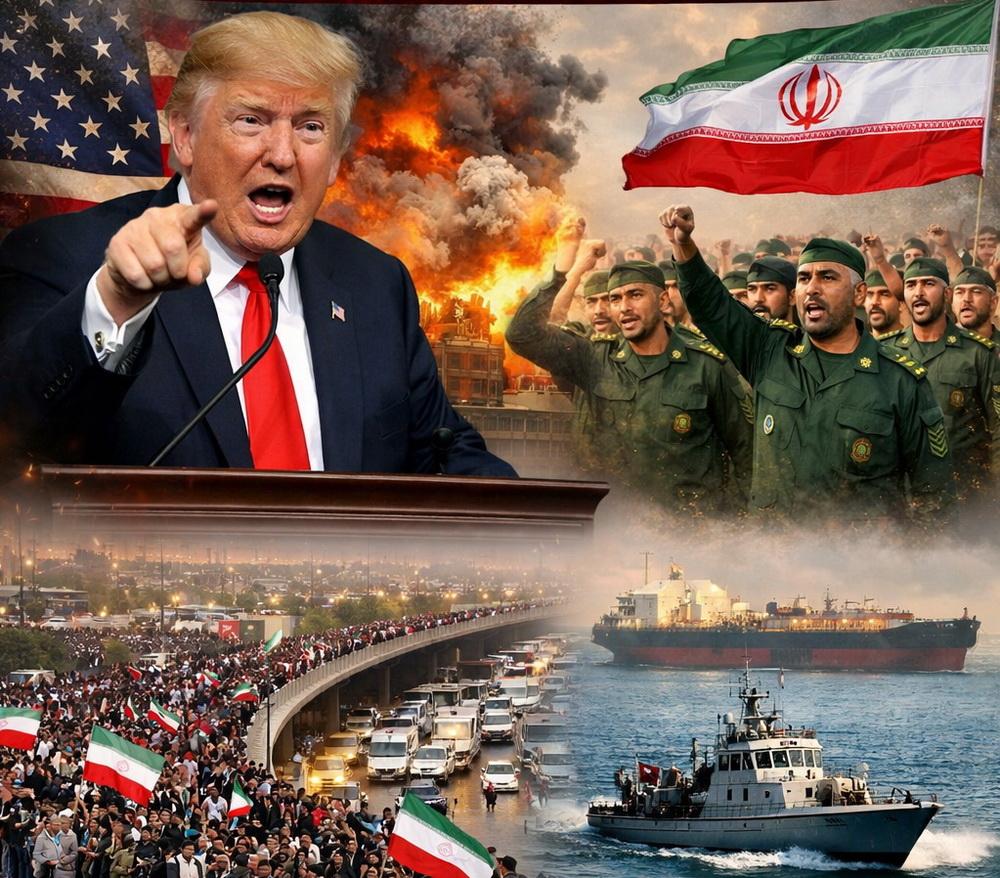
Washington/Tehran: US President Donald Trump announced a two-week temporary ceasefire with Iran, in a dramatic turn of events that has eased immediate fears of a large-scale war in the Middle East. The sudden de-escalation, coming just hours after a series of intense threats from Washington, is being widely viewed by international media and analysts as a significant diplomatic and psychological victory for Tehran.
The ceasefire announcement came at a critical juncture when the United States was reportedly on the verge of launching major military strikes against Iranian targets. However, in a last-minute decision, the Trump administration agreed to suspend planned operations for two weeks, opening a window for negotiations and reducing the risk of an immediate military confrontation.
What has added to the global surprise is the sharp contrast between the ceasefire announcement and the aggressive rhetoric that preceded it. In the hours leading up to the decision, President Trump had issued stark warnings to Iran, reportedly threatening to target key infrastructure, including bridges, power plants and other critical facilities. In one of his most controversial statements, he warned that if no agreement was reached, “an entire civilization could be wiped out overnight,” a remark that triggered widespread concern among global leaders and legal experts. Analysts noted that such threats, particularly those involving civilian infrastructure, could potentially violate international humanitarian law.
Iran, however, responded with defiance. Officials in Tehran dismissed the US warnings as “arrogant rhetoric” and made it clear that the country would not negotiate under pressure. Iranian leadership reiterated that any resolution to the conflict would have to be based on its own terms, signaling a firm and uncompromising stance even in the face of possible military escalation.
At the same time, Iran witnessed an extraordinary wave of public mobilization. Thousands of citizens reportedly took to the streets across major cities, forming human chains around key installations such as bridges and power plants. These acts were widely interpreted as symbolic and practical demonstrations of resistance, with civilians positioning themselves as protectors of national infrastructure. The images and videos of these gatherings quickly spread across global media platforms, reinforcing the perception of a united national front combining both state authority and civilian resolve.
According to multiple international reports, several factors contributed to Washington’s decision to step back from the brink. The imminent risk of a full-scale war, coupled with the uncertainty of its consequences, appears to have played a major role. There was also growing international pressure, as well as legal concerns over the potential targeting of civilian infrastructure. Within the United States, Trump’s rhetoric faced criticism from political figures and policy experts, adding to the pressure to de-escalate.
Another critical factor was Iran’s strategic leverage over the Strait of Hormuz , one of the world’s most important oil transit routes. Any prolonged disruption in this region could have triggered a global energy crisis, significantly impacting economies worldwide. Reports also suggest that diplomatic backchannel efforts, including mediation by Pakistan and other regional actors, helped facilitate the ceasefire agreement at the last moment.
As part of the broader diplomatic engagement, Iran is said to have presented a comprehensive 10-point framework outlining conditions for a long-term resolution. These include a permanent ceasefire, lifting of economic sanctions, an end to military actions against Iran, and international guarantees of its sovereignty and security. The framework also emphasizes secure navigation in the Strait of Hormuz, with greater Iranian oversight, and calls for reconstruction of war-affected areas as well as broader regional de-escalation.
The current conflict, which escalated sharply in late February 2026 following US and allied actions, has already resulted in significant casualties and widespread damage to infrastructure. Iran’s retaliatory strikes targeted military bases and strategic installations, further intensifying tensions and raising fears of a prolonged regional war. The temporary closure and disruption of maritime traffic in the Strait of Hormuz during this period had already sent shockwaves through global oil markets.
Following the ceasefire announcement, oil prices showed signs of decline while global stock markets responded positively, reflecting cautious optimism among investors. International organizations, including the United Nations, have welcomed the move and urged both sides to pursue sustained dialogue to achieve a permanent settlement.
Despite the temporary relief, analysts caution that the situation remains fragile. The ceasefire is widely seen as a pause rather than a resolution, with the outcome of upcoming negotiations expected to determine whether tensions will ease permanently or escalate once again.
For now, however, the sequence of events—from intense US threats to a sudden halt in military plans, combined with Iran’s firm stance and visible public support—has led many observers to conclude that Tehran has secured a notable strategic advantage. Whether this moment translates into a lasting peace or merely a temporary reprieve will depend on how both sides navigate the complex diplomatic path ahead.