

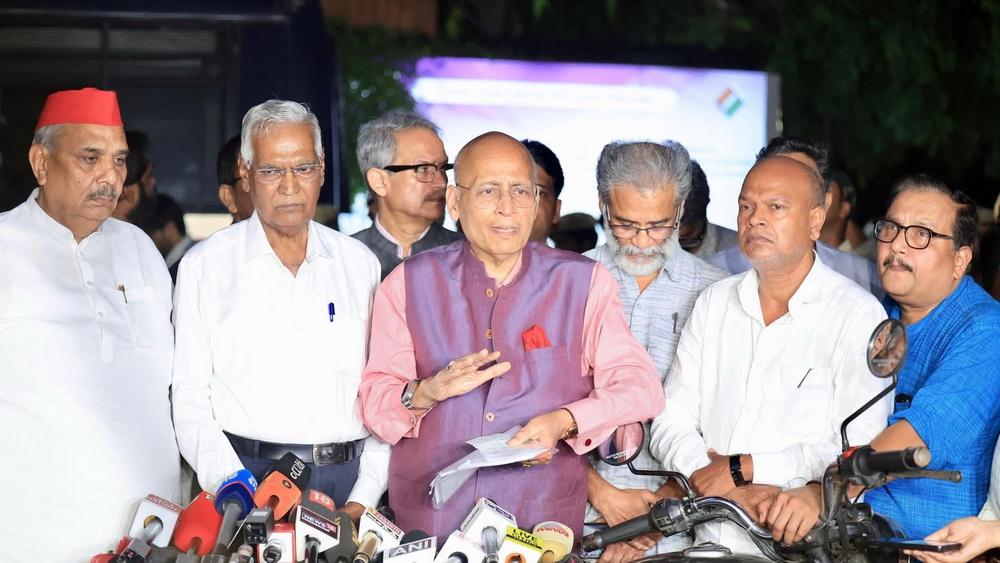
New Delhi: Eleven parties from the INDIA bloc, led by the Congress, Rashtriya Janata Dal (RJD), Samajwadi Party, and the Communist Party of India (CPI), have strongly objected to the Election Commission of India's (ECI) decision to conduct a Special Intensive Revision (SIR) of electoral rolls in Bihar, calling it ill-timed and undemocratic.
An 18-member delegation, including senior leaders Abhishek Manu Singhvi (Congress), Manoj Jha (RJD), Dipankar Bhattacharya (CPI-ML), and Bihar Congress president Rajesh Kumar, met Chief Election Commissioner Gyanesh Kumar and other election officials on Wednesday. They raised concerns over the timing, manner, and transparency of the revision process, warning that it could compromise the fairness of the upcoming assembly elections.
Singhvi noted that the sudden announcement of the SIR in late June was highly suspicious, especially since previous revisions — such as the one in 2003 — were conducted well in advance of any elections. “Now we are just a few months away from the polls, and verifying nearly 7.75 crore voters in such a short time is unreasonable,” he said.
The opposition leaders also took strong exception to the new EC rule allowing only two representatives per party — including only party presidents — into meetings with the Commission. This, they argued, undermines the democratic process and prevents meaningful dialogue.
“For the first time, we were told only party chiefs could attend. Several senior leaders like Jairam Ramesh and Pawan Khera were made to wait for hours outside,” Singhvi told the media, describing the restrictions as “unfortunate” and “arbitrary.”
Jairam Ramesh, who posted his reaction on X (formerly Twitter), accused the Commission of behaving like an extension of the ruling government. “We shudder to think what this ‘New’ Commission’s gameplan is,” he wrote, comparing the move to the 2016 demonetisation. “After the PM’s notebandi destroyed our economy, the ECI’s ‘VOTE-bandi’ in Bihar will destroy our democracy.”
Another concern raised was the documentation required for inclusion in the rolls. The delegation questioned why, for the first time, a birth certificate was being made mandatory, whereas earlier Aadhaar and ration cards were deemed sufficient. RJD’s Manoj Jha went so far as to question whether the exercise aimed to disenfranchise voters.
While the Election Commission maintained that all concerns were addressed during the meeting, opposition leaders insisted that the manner in which the revision is being carried out raises serious questions about transparency, timing, and intent — especially in a politically sensitive state like Bihar just ahead of elections.