

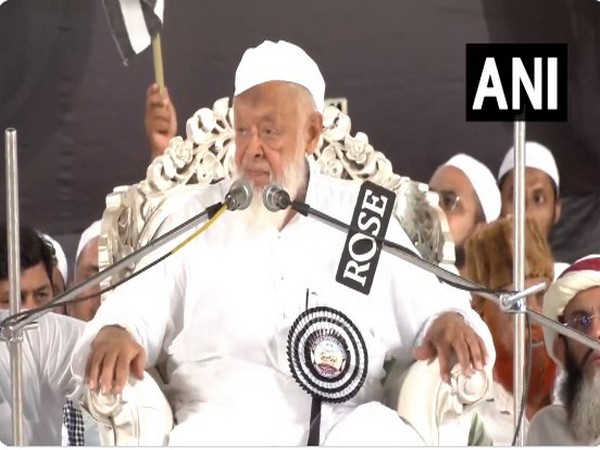
New Delhi: Jamiat Ulama-i-Hind president Maulana Arshad Madani has strongly criticised the Congress, stating that the country is facing grave consequences today due to the party’s failure to take firm action against communal forces in the aftermath of Mahatma Gandhi’s assassination.
In a detailed statement shared on social media on Wednesday, Madani said the period following Gandhi’s killing was a decisive moment in India’s history, when communalism should have been dealt with decisively and without compromise. He argued that the Congress’s lenient and accommodative approach towards religion-based politics of hatred during those early years allowed divisive forces to survive and steadily weaken the nation’s constitutional and secular foundations.
Madani said that had strict measures been taken at that time, India could have been spared much of the turmoil it is witnessing today. He expressed concern that, 77 years after Independence, the Constitution and democratic values are being openly undermined in a manner that the leaders of the freedom movement could never have imagined.
According to the Jamiat chief, fear and political hesitation led Congress leaders to adopt a soft posture toward communal elements. He alleged that instead of enforcing the law firmly, communal forces were treated with undue tolerance, enabling them to grow stronger over the decades. This, he said, resulted in long-term damage to both the country and its constitutional values.
Describing Mahatma Gandhi’s assassination as a blow to India’s secular spirit, Madani recalled that after Partition, Gandhi undertook a fast to stop anti-Muslim violence across the country. This stand, he said, angered communal groups and even caused discomfort among certain senior Congress leaders. The hostility towards Gandhi eventually culminated in his assassination, which Madani described as the symbolic killing of the nation’s secularism.
Madani also highlighted the role played by Jamiat Ulama-i-Hind in ensuring that India adopted a secular Constitution. He said the organisation consistently pressed the Congress leadership to curb communalism and to guarantee complete religious freedom for all minorities. He noted that before Independence, senior Congress leaders had provided written assurances that independent India’s Constitution would be secular.
However, he alleged that after Partition, a section of the Congress leadership argued that a secular Constitution was no longer necessary, as Pakistan had been created in the name of religion. Madani said the Jamiat leadership firmly challenged this position and held the Congress accountable to its commitments, which ultimately led to the adoption of a secular constitutional framework.
Despite this, he lamented that no effective steps were taken to restrain communal forces, even when the Congress was in power at the Centre and across the provinces. Had the party chosen to act decisively, he said, it could have enacted strict laws to curb communalism. Instead, the flexible policy it followed allowed divisive forces to entrench themselves deeply.
Concluding his remarks, Madani said that if the Congress had adopted the same firm stance against communalism in the early years of Independence that it claims to uphold today, the political trajectory of the country might have been very different, and India may not have reached its present state of crisis.