

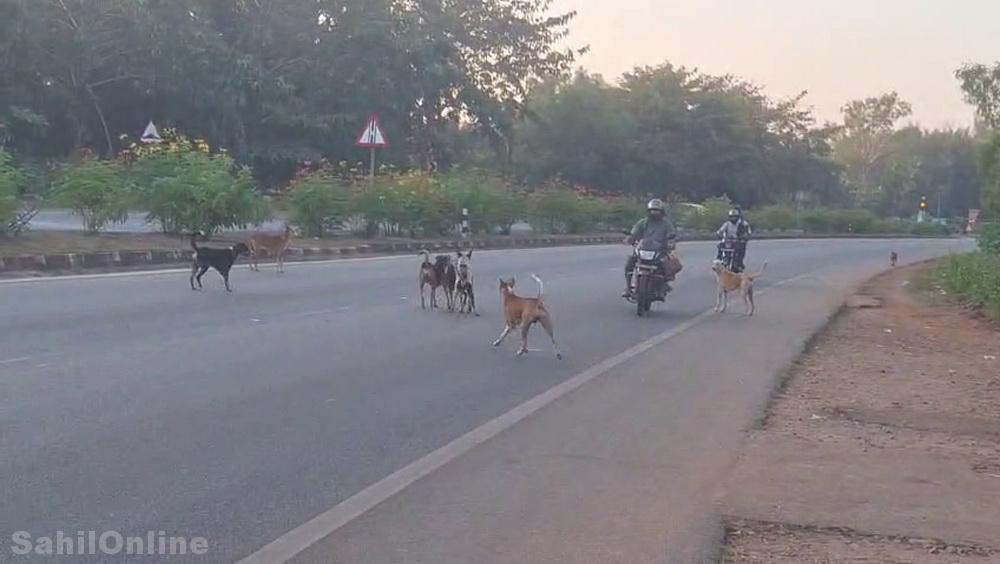
Bhatkal: Despite the Supreme Court’s directive to clear stray cattle and dogs from public areas, doubts remain about how effectively this order will be implemented in Uttara Kannada district — particularly in coastal regions like Bhatkal, where the terrain and surrounding forest zones pose significant challenges.
Across coastal Karnataka, the growing menace of stray animals has become a serious civic issue. Packs of stray dogs freely roam the streets, often attacking pedestrians, while unattended cattle occupy highways, causing frequent traffic disruptions and accidents. These situations have made daily life unsafe for residents, including children, women, and the elderly.
Taking note of the situation, the Supreme Court has directed all state governments and the National Highways Authority of India (NHAI) to remove stray animals from highways, schools, hospitals, bus stands, and railway stations, and relocate them to designated shelters. The apex court also emphasized that these animals must not be allowed to return to public spaces after relocation.
However, practical challenges remain. In districts like Uttara Kannada, where many villages are surrounded by dense forests and long coastlines, capturing and relocating these animals is a complex task that requires both manpower and infrastructure.
The matter gained national attention following a petition from Kerala highlighting the alarming rise in stray dog attacks. Reports indicate that in Kerala alone, over 1.2 lakh people have been bitten by stray dogs. A 2024 PEW report noted that nearly 20 million people across India were affected by dog attacks that year, while 2023 data revealed more than 30 highway accidents caused by stray cattle.
In Uttara Kannada, especially along the coastal stretch from Karwar to Bhatkal, stray animals are a common sight. Streets and marketplaces are often occupied by dogs and wandering cattle, leading to frequent accidents and injuries. Despite numerous public complaints, officials cite legal constraints and inadequate facilities as key obstacles in resolving the issue.
While the Supreme Court’s intervention has offered hope to the public, the real challenge lies in its execution. Whether the authorities will take effective measures or allow the problem to persist on the ground remains to be seen.