

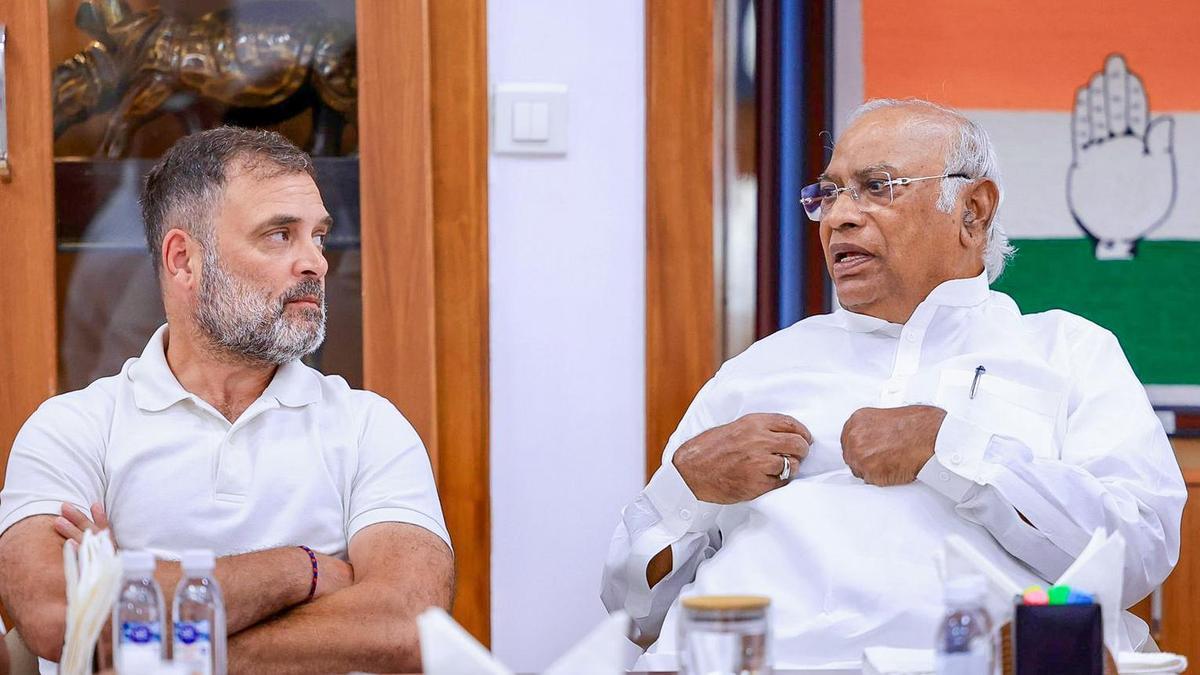
New Delhi: A day after its worst-ever performance in the Bihar Assembly elections, the Congress on Saturday convened its first high-level review meeting in Delhi. The meeting was held at the residence of Congress president Mallikarjun Kharge and attended by senior leaders including Rahul Gandhi, K.C. Venugopal, Ajay Maken and several other key members of the party’s central leadership.
According to party sources, the Congress held an in-depth assessment of its electoral performance, examined organisational shortcomings, and discussed suggestions for future strategy. The leadership is said to be closely analysing why the party suffered such a massive setback in Bihar.
Congress alleges electoral irregularities
Following the meeting, the Congress accused the BJP of widespread irregularities during the election process. Congress General Secretary K.C. Venugopal told the media that the party is collecting “substantial evidence” of alleged poll manipulation, which it plans to make public within the next two weeks.
The Congress fielded 60 candidates this time but managed to win only 6 seats. Its vote share stood at 8.71%, compared to 9.6% in 2020 when it contested 70 seats and won 19. Party leaders described the results as “highly unexpected” and demanded a thorough investigation.
Ajay Maken and other senior leaders questioned the credibility of the final results, claiming that all constituents of the Mahagathbandhan view the outcome as “surprising and suspicious”.
Major Reasons Behind Mahagathbandhan’s Defeat
1. Internal discord — from CM face to ticket distribution
Media reports indicate that the Mahagathbandhan’s tally failing to reach even 50 seats is largely attributed to the poor performance of the RJD and Congress.
Although Rahul Gandhi and Tejashwi Yadav tried to present unity through the Voters' Rights Yatra, disagreements soon surfaced over declaring Tejashwi as the coalition’s chief ministerial face.
While Congress eventually accepted Tejashwi as CM candidate, the internal friction reportedly reached voters, impacting both the campaign and ticket distribution.
2. Seat-sharing delays until the last moment
Seat-sharing between the RJD and Congress remained unresolved until the last day of withdrawal of nominations for the first phase. Candidates filed their papers without clarity on how many seats each party would contest. Eventually, the RJD contested 146 seats, Congress 59, VIP 13, CPI-ML 20, CPI 7, CPM 4, and IIP 2. This led to 250 candidates of the alliance contesting across 241 seats—resulting in widespread confusion.
3. Alliance partners contesting against one another on nine seats
Due to a lack of coordination, the Congress, RJD, and Left parties fielded candidates against each other on at least nine seats.
This division of votes allowed rival parties to easily win all of them.
For example, in Bachhwara (Begusarai), the combined votes of Congress and CPI exceeded the BJP’s tally by 5,920—but the split helped the BJP secure the seat.
(Media reports document several similar instances.)
4. Campaign promises failed to strike a chord
The Mahagathbandhan focused heavily on issues like SIR, alleged vote theft, and the health of Chief Minister Nitish Kumar. However, these narratives failed to translate into votes.
After the Voters' Rights Yatra, Rahul Gandhi became absent from the ground campaign, leaving Tejashwi Yadav to carry the burden alone. The alliance’s big-ticket promises—including one job per family, ₹30,000 assistance for women, LPG cylinders at ₹500, free treatment up to ₹25 lakh, and 200 units of free electricity—failed to gain traction among voters.
5. Nitish Kumar’s ‘10,000-rupee’ women’s scheme reshaped voter behaviour
According to Opposition leaders, Chief Minister Nitish Kumar’s Mukhyamantri Mahila Rojgar Yojana (MMRY) was the biggest factor in the NDA’s sweeping victory.
Just days before the Election Commission announced polling dates, the Bihar government transferred ₹10,000 each to over 1 crore women, amounting to more than ₹14,000 crore.
Opposition parties allege that the direct benefit transfer had a decisive impact on voter behaviour.
The NDA eventually won 174 seats—with the BJP taking 89 and JD(U) winning 85—while the Mahagathbandhan was reduced to just 35 seats.
NCP (SP) chief Sharad Pawar, quoted by PTI, said the scheme “created a favourable environment for the NDA”, drawing parallels with similar trends during the Maharashtra election.
He further questioned why the Election Commission permitted such a large-scale cash transfer when the poll announcement was imminent.